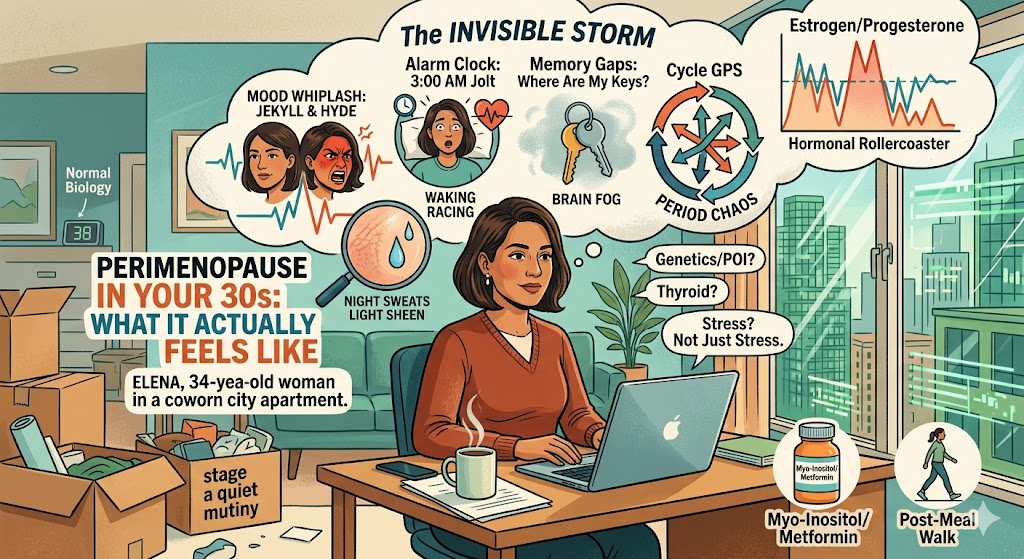
When most people think of perimenopause, they picture a woman in her late 40s or early 50s dealing with sudden hot flashes. But for a growing number of women, the hormonal roller coaster begins much earlier.
Meet Elena. At 34, she has a thriving marketing career, a busy social life, and a sudden, overwhelming sense that her body is staging a quiet mutiny. She isn’t sleeping, her mood swings are severe enough to give her whiplash, and her usually clockwork periods are suddenly acting like a broken GPS. When she brings it up to friends, they laugh it off as “just stress.”
But stress doesn’t fully explain what Elena is experiencing. Like many women in their mid-to-late 30s, Elena is experiencing early perimenopause—the transitional phase leading up to menopause. Because society tells us this is an “older woman’s issue,” young women are often left in the dark about what perimenopause in your 30s really feels like.
Let’s pull back the curtain on the lived reality of this early hormonal shift and how to navigate it.
The Phantom Symptoms: What It Actually Feels Like
Perimenopause isn’t a sudden drop in estrogen; it is a chaotic, unpredictable fluctuation of estrogen and progesterone. It feels less like a smooth fading out of fertility and more like an intense, invisible internal storm.
Here is what the symptoms feel like on a daily basis:
-
The Unforgiving “3 AM Wake-Up”: This isn’t normal insomnia. You fall asleep exhausted, only to joltingly wake up at 3:00 AM completely wired, heart racing, or drenched in a light sheen of sweat.
-
The “Jekyll and Hyde” Mood Swings: You might find yourself crying over a misplaced set of keys or feeling a surge of white-hot rage because your partner chewed their food too loudly. It feels like extreme, unpredictable PMS that stays for weeks instead of days.
-
The Vanishing Brain: You walk into a room and completely forget why you are there. You struggle to find basic words during work presentations. This terrifying “brain fog” is a direct result of fluctuating estrogen levels impacting the brain’s cognitive centers.
-
The Heavy, Chaotic Periods: Your cycle might shrink from 28 days to 21 days, or disappear for two months entirely. When your period does arrive, it might alternate between a light trickle and an alarmingly heavy flow that catches you completely off guard.
Why Is It Happening in Your 30s?
While the average age for menopause is 51, perimenopause naturally begins 4 to 10 years before your periods stop completely. That means entering perimenopause at 38 or 39 is completely within the realm of normal biology.
However, if it hits in your early 30s, it could be a sign of Premature Ovarian Insufficiency (POI) or triggered by underlying autoimmune conditions, genetics, or previous medical treatments.
The biggest challenge for women in their 30s is getting a proper diagnosis. Because doctors look at age first, symptoms are frequently misdiagnosed as clinical depression, generalized anxiety, or a thyroid disorder.
Your Action Plan: How to Take Control
If Elena’s story sounds identical to your current reality, you do not have to just grin and bear it. Here is how to advocate for your body:
1. Track Your Cycle and Symptoms
Do not rely on memory. Use a tracking app to log not just your period dates, but your daily moods, sleep quality, and physical symptoms. Bringing three months of solid data to your doctor makes it much harder for them to dismiss your experience as “just stress.”
2. Request a Comprehensive Blood Panel
While perimenopause cannot be diagnosed by a single blood test (because hormones change by the hour), your doctor should rule out other culprits. Request a full thyroid panel, Vitamin D, B12, and iron levels, which can all mimic perimenopausal fatigue and brain fog.
3. Adjust Your Lifestyle Framework
| Focus Area | The Shift to Make | Why It Works |
| Diet | Prioritize protein, healthy fats, and cruciferous vegetables. | Stabilizes blood sugar and helps the liver metabolize fluctuating hormones. |
| Exercise | Swap intense HIIT workouts for heavy strength training and walking. | Lowers cortisol (stress hormone) levels which exacerbate perimenopause symptoms. |
| Sleep Hygiene | Keep the bedroom cool and cut off alcohol 4 hours before bed. | Alcohol drastically triggers 3 AM waking and nighttime hot flashes. |
Your 30s are meant for building your life, your career, and your future—not suffering in silence. Recognizing early perimenopause for what it is allows you to seek targeted support, adjust your lifestyle, and reclaim ownership of your body.