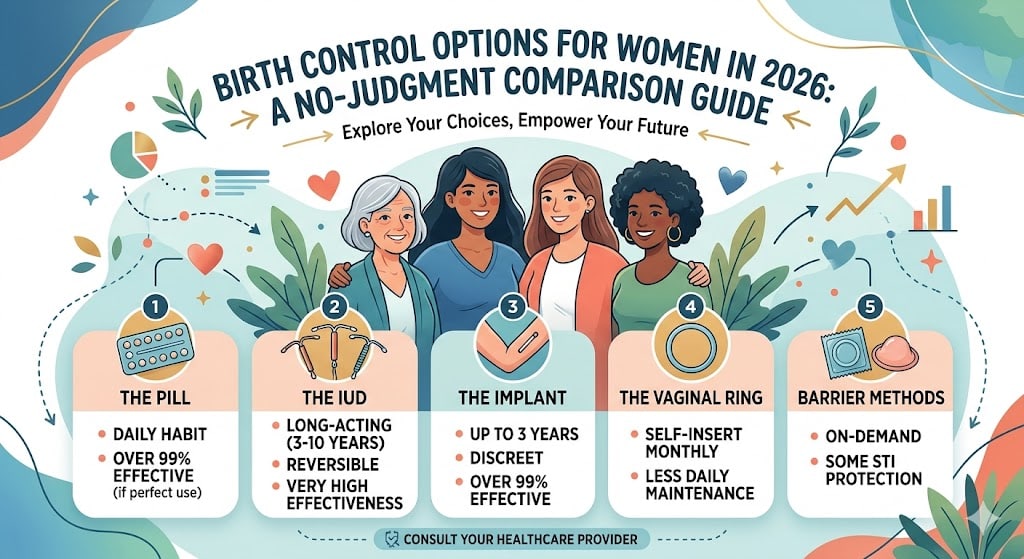
Your body, your choice — and in 2026, there are more ways than ever to make that choice work for your life. This guide walks through the main options clearly, so you can have a more informed conversation with your doctor.
1. Long-Acting Methods (Set It and Forget It)
These are inserted once by a doctor and then do their job for years — no daily routine required.
IUDs come in two types: hormonal (which uses a low dose of progestin to prevent pregnancy) and copper (which is completely hormone-free and works by making the uterus hostile to sperm). Depending on the type, an IUD can last anywhere from 3 to 10+ years.
The implant is a small, flexible rod placed under the skin of your upper arm. It releases progestin steadily and is over 99% effective for up to 3 years. It’s one of the most reliable options available.
2. Short-Acting Hormonal Methods
These give you more direct control — you decide when to start or stop.
The pill comes in two forms: combined (estrogen and progestin) and progestin-only. Beyond preventing pregnancy, many people use the pill to manage painful periods, endometriosis, or hormonal acne.
Patches and rings work similarly to the pill but are absorbed through the skin or vaginal lining instead of the digestive system. The patch is changed weekly; the ring is monthly — a good fit if a daily pill feels like too much to track.
The shot is a progestin injection given every three months. It’s discreet and highly effective, but you do need to keep up with clinic visits.
3. Non-Hormonal and Barrier Options
Condoms (external or internal) are the only method that also protects against STIs — worth remembering if that’s a factor for you.
Fertility tracking apps have come a long way. FDA-cleared versions use temperature data and algorithms to identify your fertile window with real accuracy. No hormones, no side effects — but they do require daily consistency to work well.
Tubal ligation is a permanent surgical option for those who are certain they don’t want future pregnancies.
Quick Comparison
| Method | Typical Effectiveness | Main Benefit | Worth Knowing |
|---|---|---|---|
| IUDs & Implants | >99% | Low-maintenance, lasts years | Needs a clinical fitting |
| Pills, Patches, Rings | 91–93% | Flexible, helps with cycle symptoms | Requires a routine |
| Condoms | 87–88% | STI protection | Must be used every time |
| Fertility tracking apps | 90–93% | Hormone-free | Requires daily tracking |
No single option is right for everyone. The best choice is the one that fits your health history, daily habits, and plans for the future — and your doctor can help you weigh the trade-offs.