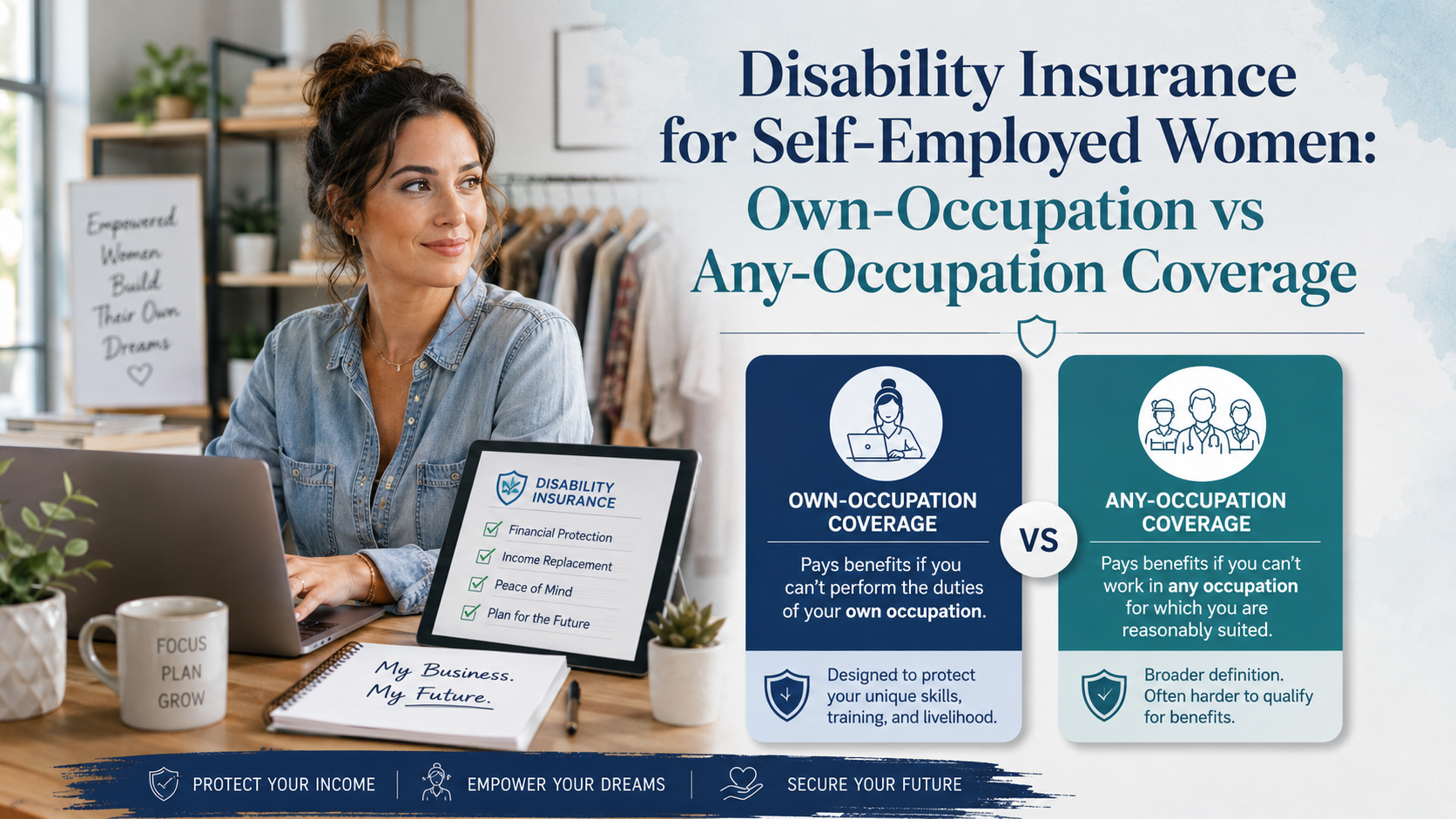
Disability Insurance for Self-Employed Women: Choosing Between Own-Occupation and Any-Occupation Coverage
By Jasmine Watts
Disability insurance is a vital financial safety net for self-employed women, ensuring protection against unexpected events that could impair their ability to work. In this article, we delve into the two primary types of disability insurance: own-occupation and any-occupation coverage. Readers will learn the differences, benefits, and key considerations of each type, empowering them to make informed decisions regarding their financial future. Self-employed women often face unique challenges without employer-sponsored benefits, making understanding these options even more crucial. We will explore the policies’ definitions, benefits, claim processes, and tax implications while integrating useful insights that can support better financial planning and risk management.
What Is Disability Insurance and Why Do Self-Employed Women Need It?
Disability insurance is a policy designed to replace a portion of a worker’s income when they are unable to work due to a disability, whether from illness or injury. It is particularly essential for self-employed women, who do not have the backup of employer-sponsored coverage. This type of insurance provides crucial financial stability during periods when self-employed individuals may struggle to manage their business and personal expenses simultaneously. Without adequate protection, a sudden loss of income could lead to severe financial strain, making it imperative for self-employed women to secure disability insurance.
How Does Disability Insurance Protect Income for Self-Employed Women?
Disability insurance serves as a financial buffer for self-employed women by providing income replacement when they cannot perform their job duties. Essentially, it allows them to maintain their lifestyle and cover necessary expenses, such as rent, utilities, or debt payments, during challenging times. By ensuring that essential costs are still met, this coverage helps provide peace of mind, empowering self-employed women to focus on recovery without the added stress of financial insecurity. This security is particularly vital for entrepreneurs and freelancers, who may not have sick leave or unemployment benefits to rely on when facing health-related challenges.
What Are the Key Policy Elements: Coverage Type, Waiting Period, and Benefit Period?
When considering disability insurance, self-employed women encounter several key elements that define the policy’s effectiveness. These elements include the type of coverage, the waiting period before benefits commence, and the duration of the benefit payments.
- Coverage Type: The two primary options are own-occupation and any-occupation coverage, which determine how disability is defined and, consequently, the eligibility to receive benefits.
- Waiting Period: This is the time between the moment a disability occurs and when benefits begin to be paid. A longer waiting period typically means lower premiums but higher out-of-pocket expenses before receiving benefits.
- Benefit Period: This denotes how long the benefits will be paid once initiated, which can vary widely depending on the specific policy.
Understanding these components is crucial for choosing the right policy that aligns with personal and professional financial needs.
What Is Own-Occupation Disability Insurance and What Benefits Does It Offer?
Own-occupation disability insurance is a type of coverage that provides benefits if the policyholder is unable to perform their specific job or occupation. This is particularly advantageous for self-employed women in specialized fields, as it ensures they receive financial support even if they can still work in another capacity. For example, a graphic designer who cannot create due to a disability would still receive benefits despite being able to work in other areas of their expertise.
How Does Own-Occupation Coverage Define Disability for Specialized Careers?
The definition of disability in the context of own-occupation coverage is tailored to the policyholder’s specific profession and skills. This means that if an individual can no longer perform the exact duties of their occupation but is fit to work in other roles, they would still qualify for benefits. This nuanced approach allows for greater security and peace of mind for self-employed women, as their unique qualifications and career paths are considered rather than a generic assessment of their overall ability to work.
Why Is Own-Occupation Coverage Growing in Importance for Freelancers and Entrepreneurs?
The rise in freelance and entrepreneurial roles highlights the importance of own-occupation coverage for self-employed women. As more women enter specialized fields, the need for tailored financial protection becomes essential. Own-occupation coverage supports a diverse range of professions, recognizing the unique skills and contributions of freelancers and entrepreneurs. Additionally, as the landscape of work evolves, traditional insurance policies may not provide adequate protection, causing self-employed women to seek more comprehensive and suitable options that meet their specific needs.
How Does Any-Occupation Disability Insurance Differ and When Is It Suitable?
In contrast to own-occupation coverage, any-occupation disability insurance defines disability based on whether the policyholder can perform any job, not just their own. This may restrict benefits if the individual can work in a less specialized position. While typically more affordable than own-occupation policies, any-occupation coverage may not be ideal for self-employed women whose skills are specialized, as it can lead to potential financial insecurity if they are unable to work in their usual field. However, this type of policy may suit individuals experiencing changes in their career or those with flexible job descriptions.
What Are the Limitations and Risks of Any-Occupation Coverage for Self-Employed Women?
One of the primary limitations of any-occupation coverage is the stricter criteria for proving disability. Individuals must demonstrate an inability to work in any capacity, which can lead to claim denials if they are deemed fit for different jobs. This can create financial risks for self-employed women who may rely solely on their specific skills and may face difficulty securing alternative employment if they become disabled. Understanding these limitations is crucial for making informed decisions about the right insurance coverage.
Who Should Consider Any-Occupation Coverage Based on Career Flexibility and Budget?
Any-occupation coverage may be suitable for those working in roles with varying responsibilities or less specialized skills. Additionally, it may appeal to self-employed women with budget constraints who seek basic disability coverage at lower premiums. Evaluating one’s career flexibility and potential job opportunities will help in deciding if this type of insurance aligns with their financial and professional goals. Careful consideration of individual circumstances, risks, and budgeting can guide the choice of coverage type.
How Do Premium Costs Compare Between Own-Occupation and Any-Occupation Policies?
When evaluating disability insurance, premium costs are a significant factor. Generally, own-occupation policies have higher premiums due to the tailored support they offer for specialized skills. The additional security of being able to claim benefits even when capable of other work makes these policies more expensive.
What Factors Influence Disability Insurance Premiums for Self-Employed Women?
Several factors affect the premiums for disability insurance, including:
- Age and health status: Younger and healthier individuals typically face lower premiums.
- Occupation: High-risk jobs may incur higher rates due to the increased likelihood of claims.
- Coverage amounts and terms: Higher benefit amounts or shorter waiting periods generally lead to increased premium costs.
By understanding these influencing factors, self-employed women can make strategic choices regarding their coverage options and budget their expenses effectively.
How Can Self-Employed Women Budget for Cost-Effective Disability Insurance?
Budgeting for disability insurance requires careful planning. Self-employed women should assess their current expenses and compare various policy options to find coverage that provides adequate protection without exceeding their financial limits. Additionally, seeking advice from financial advisors or insurance experts can offer insights into cost-effective solutions. Strategies such as analyzing bundled insurance options or reviewing multiple quotes can also help ensure they secure the best coverage within their budget.
What Is the Claim Process for Disability Insurance and How Can Self-Employed Women Prepare?
Understanding the claim process for disability insurance is crucial for self-employed women, as it can vary between policies. Typically, claims involve providing documentation regarding the disability, medical records, and proof of income.
What Are the Step-by-Step Actions to File a Disability Insurance Claim?
- Notify your insurer: As soon as a disability arises, inform your insurance company to initiate the claims process.
- Gather documentation: Compile necessary medical records and income proof, including tax returns or profit and loss statements.
- Complete the claim form: Fill out the required forms with accurate information reflecting your disability and circumstances.
By preparing documentation in advance and understanding the necessary steps, self-employed women can facilitate a smoother claim process.
How Do Own-Occupation and Any-Occupation Coverage Impact Claim Approval?
The type of coverage has a direct impact on how claims are assessed. Own-occupation coverage tends to be more favorable during the claim approval process, as it considers the individual’s ability to perform their specific work. In contrast, any-occupation coverage requires proof that the individual cannot work in any job, leading to potentially higher claim denial rates. Awareness of how these distinctions affect claim processes equips self-employed women with knowledge to effectively manage their disability insurance.
How Do Tax Considerations Affect Disability Insurance for Self-Employed Women?
Tax considerations are pivotal when evaluating disability insurance. For self-employed individuals, understanding the implications attached to policy contributions and benefits can lead to more strategic financial planning.
Are Disability Insurance Premiums Tax-Deductible for the Self-Employed?
Disability insurance premiums are generally considered a deductible business expense for self-employed individuals if the coverage is for non-owner purposes. This can help reduce the overall tax burden and make insurance more affordable. Understanding the specific tax laws applicable to disability insurance will enhance budgeting and financial decision-making.
What Tax Implications Arise When Receiving Disability Benefits?
When receiving disability benefits, the tax treatment can vary based on whether the premiums were paid with pre-tax or post-tax money. If premiums are tax-deductible, the benefits received are typically taxed as income. Clarifying these tax implications can help self-employed women plan for their financial future while actively considering how disability insurance fits into their long-term fiscal strategy.