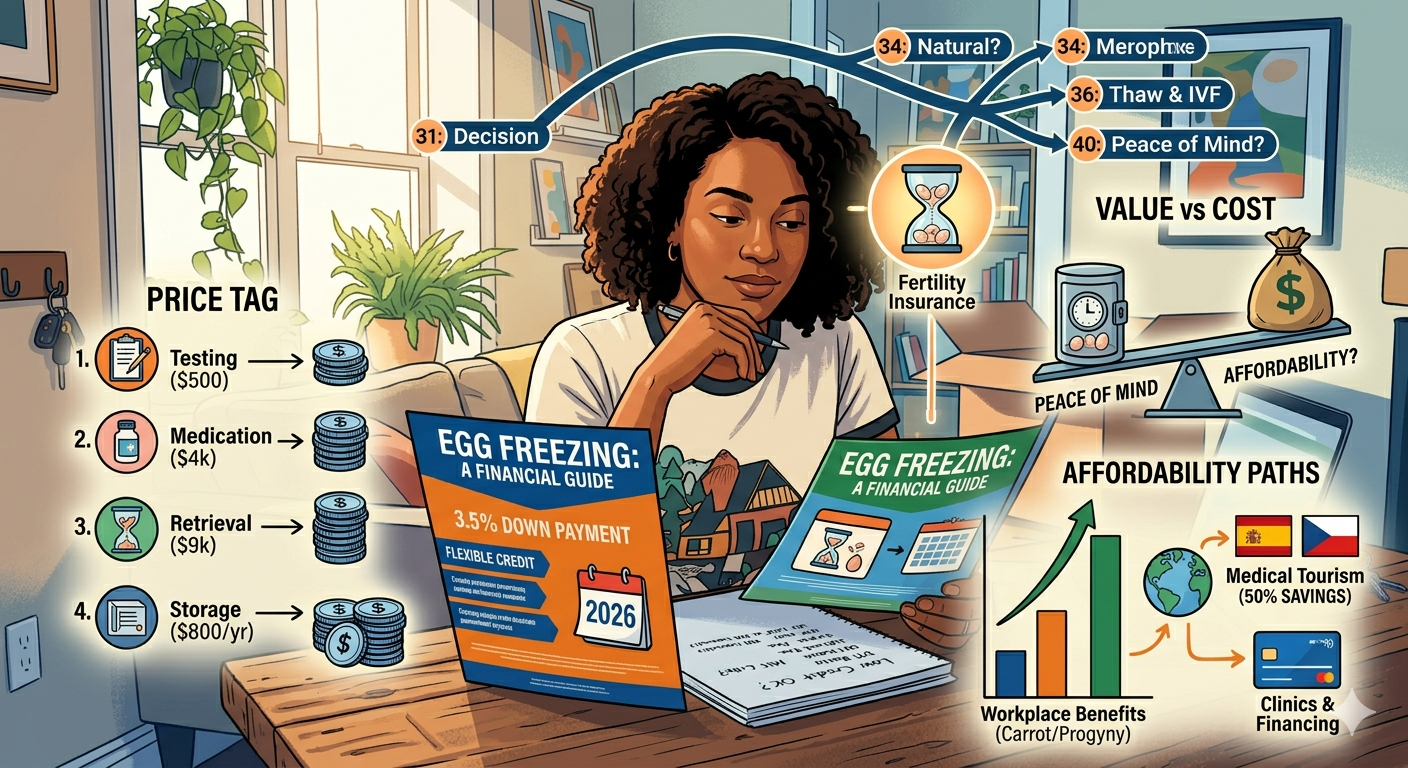
Meet Maya. At 31, her career as a software engineer is taking off, but her personal life is on pause. She knows she wants children someday, but right now, the timing isn’t right. Like thousands of women navigating modern adulthood, Maya is considering buying herself some time—and reproductive insurance—by freezing her eggs.
But as she opens her laptop to research, the empowering narrative hits a very real, very steep wall: the financial reality. If you are asking yourself what the true egg freezing cost looks like, whether it is actually worth the investment, and how you can realistically afford it, you are not alone.
Let’s pull back the curtain on the real numbers of fertility preservation.
Chapter 1: The Sticker Shock – Breaking Down the Real Cost
When Maya first searched for clinic prices, she saw numbers around $8,400 to $11,000 for a base procedure. “Steep, but doable,” she thought. But a standard clinic quote rarely tells the whole story.
An egg freezing cycle is not a flat fee; it is a multi-step medical process. A complete breakdown of what a single cycle actually costs includes:
-
The Preliminary Testing: Before anything begins, initial consultations, ultrasounds, and ovarian reserve blood tests (like AMH) will run between $200 and $800.
-
The Base Retrieval Fee: This covers clinic monitoring, the surgical egg retrieval under anesthesia, and the initial lab preservation, averaging $4,200 to $11,000.
-
The Medications: This is the most common hidden surprise. The hormone injections required to stimulate egg production are paid directly to pharmacies, costing anywhere from $2,000 to $6,000+ per cycle.
-
Annual Storage Fees: Keeping your timeline on ice isn’t free. Storage costs generally run $500 to $1,000 every single year.
The True First-Year Total: For a single cycle, most women realistically pay between $11,000 and $20,000. Furthermore, depending on your age and ovarian reserve, you may need two or three cycles to harvest a secure number of eggs, potentially pushing the upfront cost past $30,000.
Chapter 2: Is It Worth It? Weighing Value vs. Cost
To decide if the math makes sense, Maya had to weigh the financial cost against the emotional value.
The Biological Reality
Fertility declines with age, particularly after 35. Freezing eggs in your early 30s locks in your egg quality at that exact age. Think of it as a biological time capsule. For Maya, the primary value is emotional peace of mind—the freedom to date without a ticking clock and focus on her career without panic.
The Financial Catch
Egg freezing is a backup plan, not a guarantee. There is a chance Maya may conceive naturally later and never need her frozen eggs. Additionally, thaw-and-use rates mean that returning to use those eggs later via IVF introduces an entirely separate round of costs, often ranging from $10,000 to $19,000 for fertilization and embryo transfer.
Ultimately, it is worth it if you view it as insurance: you hope you never have to use it, but you are glad the option exists.
Chapter 3: Can You Afford It? Creative Ways to Pay
Faced with a $15,000 bill, Maya didn’t give up. Instead, she looked into modern affordability strategies that make fertility care accessible:
1. Workplace Benefits
The corporate landscape has shifted dramatically. Roughly 20% of large U.S. employers now offer fertility benefits through specialized providers like Carrot or Progyny, which completely or partially cover egg freezing. Maya checked her company’s handbook and discovered her insurance covered one full cycle.
2. Fertility Financing and Bundles
Many clinics offer dedicated, low-interest fertility financing plans with monthly payments under $200. Additionally, ask clinics about multi-cycle packages or “shared risk” programs, which can discount subsequent retrievals by 10% to 15% if you need more than one round.
3. Medical Tourism
An increasing number of women travel abroad for care. While a cycle in the U.S. pushes past $12,000, prominent clinics in Spain, Greece, or the Czech Republic offer the entire procedure for $2,000 to $5,000. Even with travel expenses, medical tourism can cut total costs in half.
The Ultimate Checklist
Before making your decision, take these practical steps to evaluate your budget:
| Action Step | What to Look For |
| Check Insurance | Ask HR explicitly about “fertility preservation coverage”. |
| Get an AMH Test | This $200 blood test tells you how many cycles you will likely need. |
| Ask About Hidden Fees | Ask clinics: Are medication estimates and Year 1 storage included? |
By understanding the true variables behind the price tag, you can transform a daunting financial obstacle into an empowered, calculated investment in your future self.